
Lavaca County Court Records After Arrest
After a Lavaca County jail arrest, the first public record may be the booking entry in the Lavaca County Jail portal. That custody record can list the person's name, admit date, charge text, bond amount, bond type, charging agency, and arresting agency. It is useful, but it is not the same thing as the court record. Court records after a jail arrest are built when a complaint, information, or indictment is filed and a criminal case is tracked by a clerk.
The local route depends on the charge level and court. Lavaca County misdemeanor matters commonly involve county-court records and County Attorney review. Felony matters are routed through district court records and the district clerk. The County Attorney page identifies James M. Reeves as Lavaca County Attorney, and official county minutes reference Sheriff Steven E. Greenwell for sheriff-office matters. The prosecutor's filing decision can leave the final court charge different from the jail booking charge.
For custody details, use Lavaca County jail inmate records. For booking photos, use Lavaca County jail mugshots. Court records after a jail arrest answer a different set of questions: what charge was filed, what court has the case, whether the charge is pending, dismissed, amended, reduced, or disposed, and whether a conviction was entered.
Lavaca County Court Record Routing
The county's two main criminal-record routing points are the county clerk and the district clerk. The Lavaca County Clerk page lists the office at 412 N. Texana, P.O. Box 326, Hallettsville, TX 77964, with phone 361-798-3612, fax 361-798-1610, and open-records email Countyclerk@co.lavaca.tx.us. Its posted hours are Monday through Friday, 7:45 AM to 4:30 PM, closed for lunch from 12:00 PM to 1:00 PM. That office is the safer first call for county-court misdemeanor records when the case belongs with the county clerk.
The Lavaca County District Clerk page identifies Lori A. Wenske as district clerk and lists the physical office at 109 N. LaGrange, Hallettsville, with mailing address P.O. Box 306, Hallettsville, TX 77964. The phone is 361-798-2351. The page says the office is open Monday through Friday, 8:00 AM to 12:00 PM and 1:00 PM to 5:00 PM. District criminal e-filing became mandatory in Lavaca County on January 1, 2020, so filed felony records and district criminal search questions should be routed there.
| Record Need | Local Route | Useful Details |
|---|---|---|
| County-court misdemeanor case | Lavaca County Clerk | Ask by name, case number if known, date range, and record type. |
| District criminal or felony case | Lavaca County District Clerk | Use the defendant name, case number if known, and filing date if available. |
| Prosecutor filing question | Lavaca County Attorney | James M. Reeves, 109 N. La Grange, phone 361-798-4757. |
| Jail custody or bond change | Lavaca County Jail | Call the jail at 361-798-2420 before treating roster bond data as final. |
Find Lavaca Court Records After Arrest
The statewide re:SearchTX court-records portal can be a useful search route when the Lavaca court participates and the user's access level allows the record or document to appear. It should not be treated as a replacement for the local clerk. Some records require clerk help, a copy request, or an in-person search because document visibility can depend on role, court participation, and state access rules.
- Start with the defendant's full name from the jail roster, because the booking record may show spelling, age, and admit date.
- Search re:SearchTX by party name or case number if one is known, then narrow by location or court when the portal allows filters.
- Check the county clerk for misdemeanor records and the district clerk for district criminal records when the statewide portal does not answer the question.
- Compare the filed charge with the jail charge before assuming they are the same.
- Request copies or a clerk search when a disposition, judgment, or docket entry is not visible online.
The eFileTexas system is a filing portal, not a simple public inmate search. Lavaca County clerk pages reference e-filing and attorney filing rules, which means filed criminal documents may move through that system, but members of the public still use the clerk, re:SearchTX, or a records request to view available court records after an arrest.
The re:SearchTX screen captured in the project image set shows the statewide court-search entry point. Use it as a case-search lead, then confirm the result with the proper Lavaca County clerk when a charge status, court date, or disposition matters.
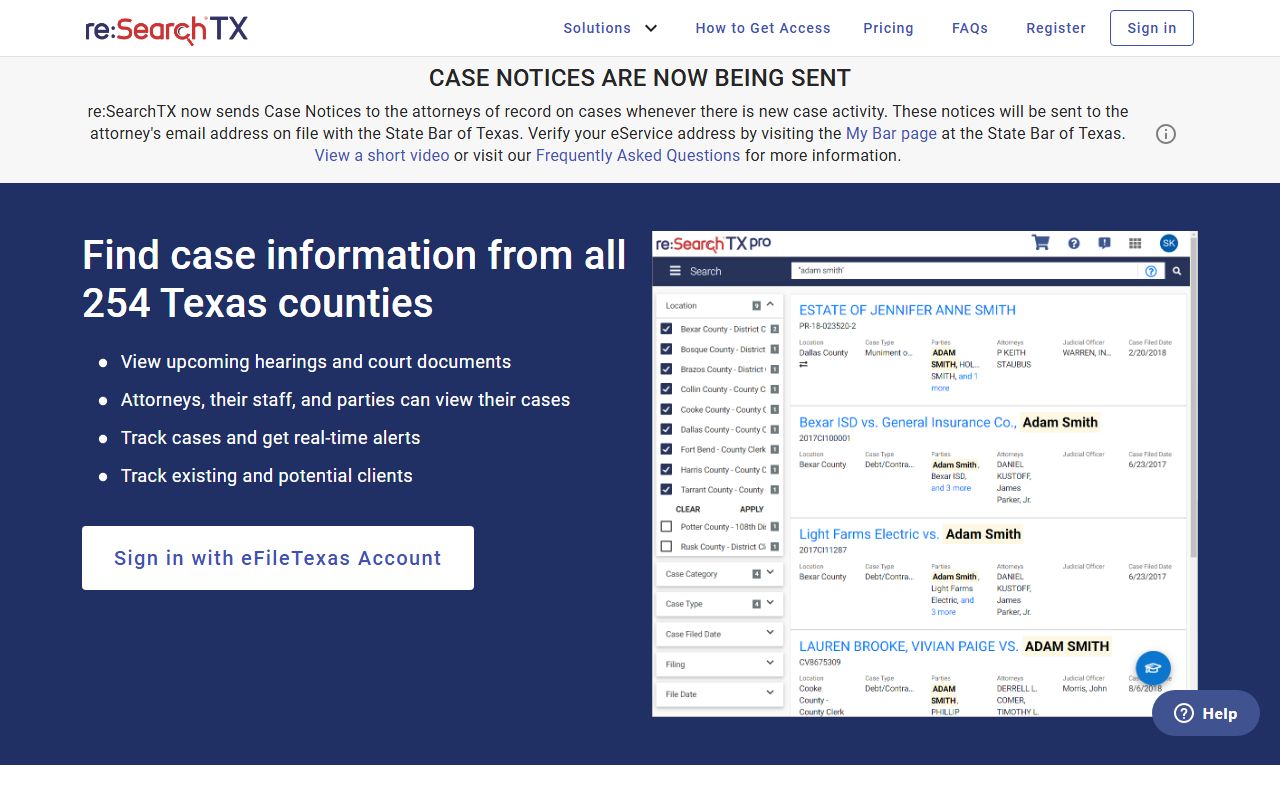
That image fits the court-record workflow because it shows the state portal used after the jail booking stage, while the local clerks remain the controlling route for official copies and searches.
Charging Documents After Lavaca Arrest
A required charging document is what turns an arrest allegation into a filed court case. In Texas criminal practice, the route can involve a complaint, an information, or an indictment. The exact path depends on the offense level, prosecutor review, grand-jury action where required, and the court that has jurisdiction. A jail charge is an intake label. A charging document is the court-filed accusation.
| Document | Used For | Why It Matters |
|---|---|---|
| Complaint | Initial criminal accusation or sworn charging basis | Can support early court action and may appear before a later filing changes the case path. |
| Information | Prosecutor-filed charge, often used in misdemeanor cases and some waived indictment settings | Shows the formal charge the prosecutor elects to pursue. |
| Indictment | Grand-jury felony accusation | Opens or advances a felony prosecution in district court. |
The Lavaca County Attorney page is relevant because the prosecutor reviews allegations and files or declines charges within the office's duties. The research did not identify a local felony district-attorney page in the county site capture, so final copy should avoid naming a felony prosecutor that was not sourced. Clerk records, not the jail portal, are the public trail once the case is filed.
Lavaca County Charge Status Records
Charge status can change after an arrest. The Lavaca County Jail profile sample showed booking-charge descriptions such as bail jumping or marijuana possession, plus offense date, bond, bond type, charging agency, and arresting agency. Those fields help locate the right case, but a prosecutor may file a different charge, amend the wording, reduce the level, add a count, dismiss a count, or decline to file. Court records after a jail arrest should be read with that sequence in mind.
| Status | Plain Meaning | Where to Confirm |
|---|---|---|
| Pending | The charge has not reached final disposition. | Clerk docket or court setting. |
| Amended | The filed charge text, count, or level changed. | Charging document and docket entries. |
| Reduced | The charge moved to a lower level or lesser offense. | Judgment, plea papers, or amended filing. |
| Dismissed | The court record shows that the charge was dropped by order or filing. | Dismissal order or docket entry. |
| Convicted | A plea or verdict produced a conviction. | Judgment and sentence record. |
| Deferred adjudication | The court deferred a finding of guilt under court-ordered terms. | Order and later disposition record. |
The official Lavaca jail charges grid is tied to booking charges rather than final court disposition. It is a useful lead for names and charge text before checking the clerk record.
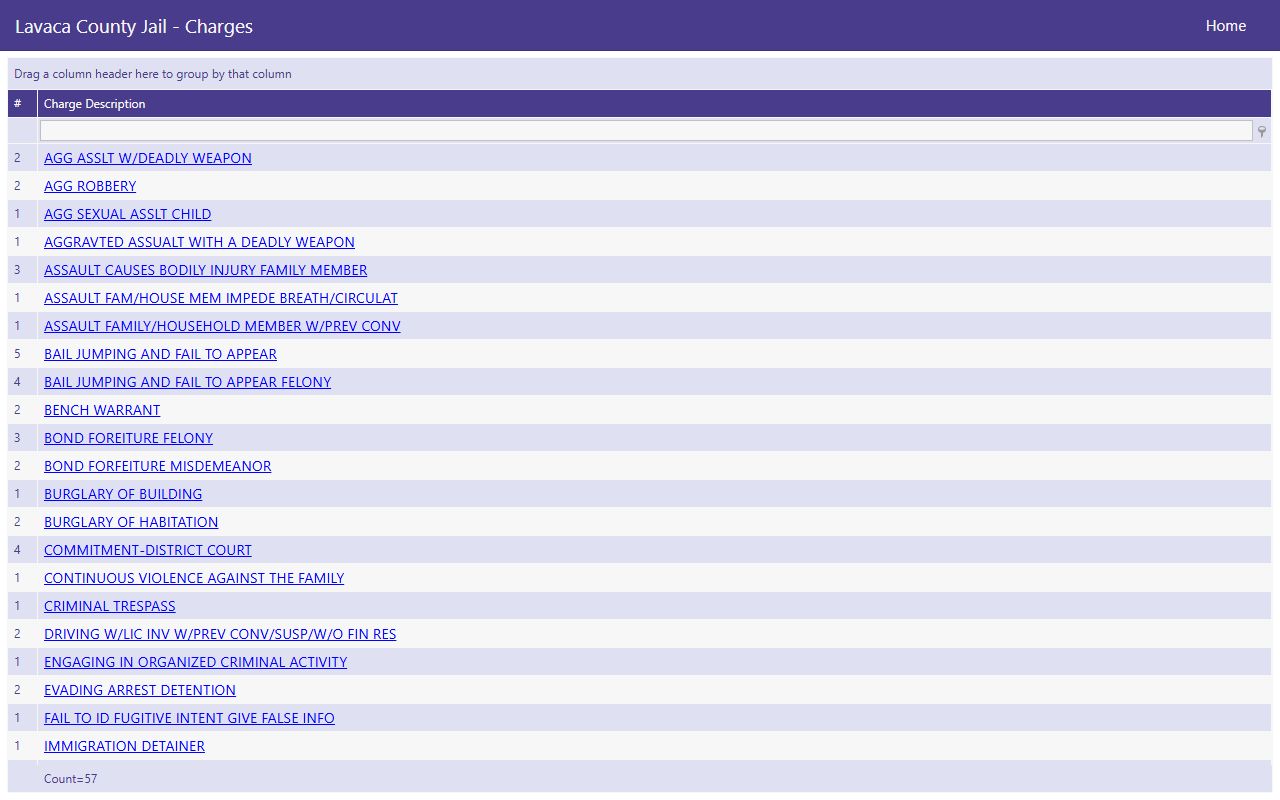
The follow-up step is the court file, because the clerk record is where filed charge status and final outcomes are confirmed.
Article 15.17 and Bond
Texas Code of Criminal Procedure Article 15.17 is the early post-arrest rule. It requires an arrested person to be taken before a magistrate without unnecessary delay, generally no later than 48 hours after arrest. At that stage, warnings address the accusation, right to counsel, right to remain silent, and bail-related issues. This is why bond and first appearance matter in court records after a jail arrest.
Lavaca County Jail profiles can show bond and bond type per charge. The sample inspected in the research showed surety-bond entries, but the public roster is not the final legal authority. Texas Code of Criminal Procedure Chapter 17 governs bail, and court orders control when there is a conflict between a jail display and the clerk or magistrate record. A hold, detainer, parole warrant, out-of-county warrant, federal matter, or ICE interest may block release even when one charge lists a bond.
| Bond Type | How It Works |
|---|---|
| Cash bond | Money is posted directly where the court or jail permits direct payment. |
| Surety bond | A licensed bail bond company posts bond for a fee and guarantees appearance. |
| Personal bond or PR bond | The person signs a promise to appear and comply with release terms. |
| No-bond hold | Release is blocked by a court order, warrant, parole hold, detainer, or other legal reason. |
Warrants Before a Lavaca Arrest
The official sheriff page did not publish a public active-warrant database or most-wanted search during the research. A warrant can still be the reason a person appears in court records after a jail arrest. The jail roster may show a failure-to-appear charge, bench-warrant custody, or another hold after the person is booked, but it should not be treated as a full warrant index.
Use the sheriff main phone at 361-798-2121 for sheriff-office questions and the jail line at 361-798-2420 for current custody after arrest. If the warrant came from a filed case, contact the county clerk or district clerk with the case number or defendant name. Municipal, JP, traffic, and Class C matters may require the issuing court. The Lavaca County Justice of the Peace page places JP Precinct 1 at the Criminal Justice Center, 38 FM 318, which is a useful local clue for some lower-court routing.
Charge vs Conviction
A charge is an accusation. A conviction is a final legal outcome reached by plea, verdict, or qualifying adjudication. Court records after an arrest may contain both, but they do not mean the same thing. A person can be booked, charged, released on bond, have a case dismissed, or later be acquitted. Treating a booking charge as a conviction is a serious records error.
| Point | Charge | Conviction |
|---|---|---|
| Stage | Accusation after arrest or filing | Final finding through plea or verdict |
| Proof | Based on probable cause or a filed allegation | Requires proof beyond a reasonable doubt or accepted plea |
| Record meaning | Shows what was alleged | Shows legal responsibility was entered |
| Where to verify | Charging document and docket | Judgment, sentence, or disposition entry |
Sealed vs Expunged Records
Texas record clearing is fact specific. Texas Code of Criminal Procedure Chapter 55A governs expunction of qualifying criminal records. Expunction is different from sealing or nondisclosure. The research did not locate a Lavaca County local expunction form packet in the captured material, but the district clerk page links an expunction directory and court resources.
| Point | Sealed or Nondisclosed | Expunged |
|---|---|---|
| Public visibility | Hidden from many public searches when an order applies | Removed or destroyed for qualifying records under court order |
| Agency access | Some agencies may keep limited access under law | Access is sharply limited after a valid expunction order |
| Common trigger | Eligible disposition or statutory nondisclosure route | Eligible dismissal, acquittal, no-charge result, or other Chapter 55A basis |
| Practical step | Check court order and agency compliance | Use the clerk process and notify agencies named in the order |
Juvenile records, sealed cases, expunged matters, active investigations, and confidential victim data may not appear in ordinary public court searches. Texas Government Code Chapter 552 makes public information generally available, but exceptions and other confidentiality laws still matter.
Public Access Limits After Arrest
Texas Government Code Chapter 552, the Texas Public Information Act, is the main open-records law. Section 552.021 gives the public a right to inspect or copy public information from a governmental body unless an exception applies. Section 552.029 is important for inmate information because it requires release of certain basic information about a person confined in a jail or prison even when some law-enforcement exceptions are claimed.
That access is not unlimited. Law-enforcement exceptions, juvenile confidentiality, sealed records, expunction orders, and custody-image rules can restrict what is released. For booking photos and custody images, Texas Government Code Section 552.1085 is relevant. For death-in-custody records, Article 49.18 provides a separate accountability route.
Important: The search tools and reference content are not consumer reports and cannot be used for FCRA-covered decisions.